



I recently heard a podcast with mega-coach and serial entrepreneur Tony Robbins in which he identified the three decisions he sees people make every moment of their lives:
What do you focus on?
What does it mean?
What are you going do about it?
We often think about “life decisions” as major forks in the road like career or marriage choices, and weighty ethical dilemmas, but from this perspective, any moment of any day of your life is likely full of choices to make.
What of the many things you could focus on will you focus on?
How will you choose to interpret what you’ve chosen to look at?
How will you choose to alter your behavior as a result of your interpretation?
Since the most important difference between the artificial intelligence (AI) of machines and the real intelligence (RI) of humans is the agency humans possess and the identity that is forged through those choices, these three domains of choice can be seen as emblematic of our humanity.
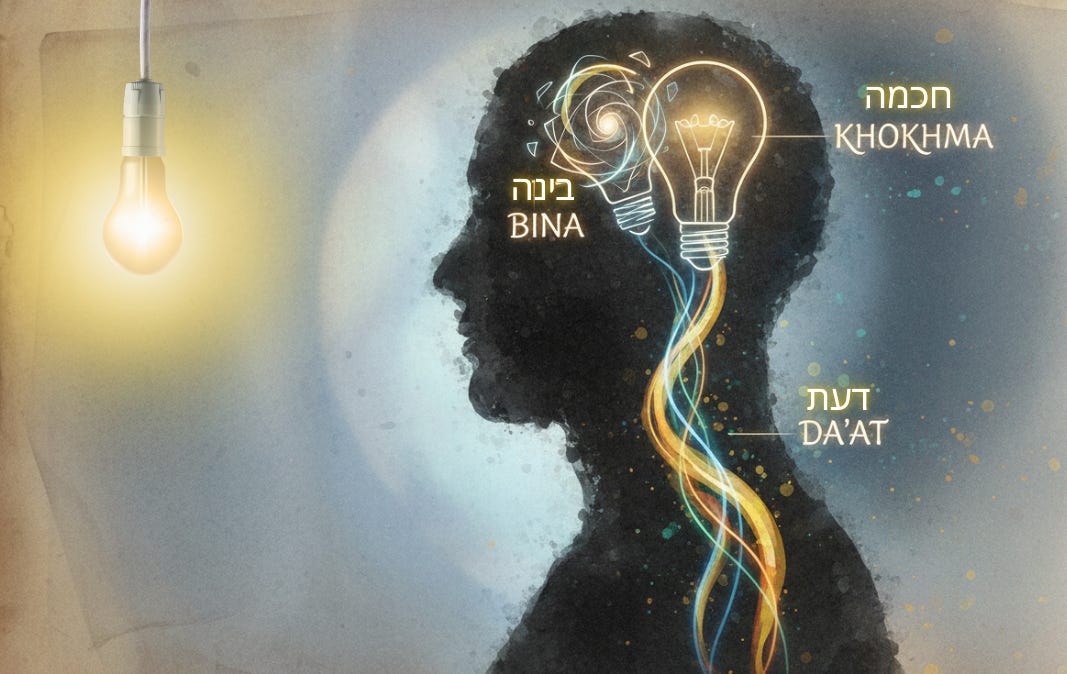
I want to suggest that they correspond to the three Hebrew words:
khokhma-חכמה
bina-בינה, and
da’at-דעת,
the three central words for intelligence.1
Before we continue, an important disclaimer:
The purpose of this post and my last one is not to prophesy an imminent AI armageddon, nor to discourage its use. My intent is to use the Divinely precise language of Hebrew to identify the uniquely human dimensions of intelligence, which are more important than ever for us to recognize and cultivate. The goal is that we preserve and deepen our RI so that we can use AI to amplify our positive impact on the world without losing ourselves in the process.2
“The goal is that we preserve and deepen our RI so that we can use AI to amplify our positive impact on the world without losing ourselves in the process.”
OK, here we go:
1. What Do You Focus On? (khokhma-חכמה)
This was our topic last post. The world is big and complicated. At any given time, all people have multiple things going on and must choose what they focus on. Life is constantly demanding from us that we distinguish between what’s important and what’s more important.3 If we don’t learn to do this, we will instinctively chase the closest, shiniest object.
Especially in the looming “Age of Abundance,” our modern world has made this work more difficult and more vital. Due to our overwhelming access to information, goods and services, combined with algorithms ingeniously trained to irresistibly put them in front of us at all times, we now bear even more responsibility in discerning what we should be pursuing and when’s the right time to pursue it.
This ability of know what we need and appreciate when we find it is called in Hebrew khokhma-חכמה. The Zohar teaches us that this is alluded to in the letters that make up khokhma-חכמה which can be reordered to spell koakh mah-כח מה, the “power of ‘what?’” Modern technology gives its users access to the entire universe, but it is the user who must now more then ever, choose what he’s looking for, and care enough to look in the first place. AI does not solve the wisdom problem for us. It amplifies it.
“Modern technology gives its users access to the entire universe, but it is the user who must now more then ever, choose what he’s looking for, and care enough to look in the first place. AI does not solve the wisdom problem for us. It amplifies it.”
What else makes human intelligence real intelligence?
2. What Does it Mean? (Bina-בינה)
The appreciation of knowledge is what fuels people to seek out and absorb ideas from the world around them, but what’s meant to happen after they have done so?
“I found the information I was looking for…what am I supposed to do with it?”
My father has mentioned to me on multiple occasions that he has hired graduates from the fanciest of Ivy League universities, who produce beautiful slide decks with complex mathematical analyses to back them up, but too often, when he asks them “what does it all mean?,” they don’t know what he’s asking them for.
The problem is that for most people, school was entirely about the acquisition of knowledge. We listened to teachers talk. We took notes. We crammed, took tests, cranked out papers, rinsed, and repeated for two decades or so.
Technological changes over the last 30 years have for the most part obliterated this model. Students tend to feel, now more than ever, that they can just listen to recordings at 2x speed, watch a YouTube or Khan Academy video, or just ChatGPT to get the content they need.
Let’s say that they’re right.4 They can get to the information they need. What would be the next step? What is one meant to do with a new piece of information he’s learned? In Hebrew, the word for this next step is bina-בינה. Bina is what deepens, broadens, and enriches understanding with insight.5 Bina is the process of meaning-making.
Richard Feynman, one of the greatest physicists and teachers of the 20th century, explained that most intelligent people are satisfied with merely “knowing things.” What makes truly brilliant people brilliant is not that they’re necessarily smarter, but that they consistently ask themselves and their teachers, “OK fine, but what does this mean???”
Whereas wisdom (khokhma) is the absorption of ideas, understanding (bina) develops only through the digestion of those ideas. I can watch a video on how to fix my car’s engine, but that does not mean I will understand how it works, or why I would be fixing a particular problem in a certain way and not any other. To get to bina, I must question every step along the way. There is no shortcut to understanding how an engine works without breaking it apart into its pieces, and putting it back together. This is why the word “bina-בינה” shares the same root letters as “boneh-בונה,” which means “build.” Bina can only emerge from a person deconstructing and reconstructing things and ideas.
![BMW S54 engine torn down [1280 × 941] : r/MachinePorn](https://substackcdn.com/image/fetch/$s_!JZUp!,f_auto,q_auto:good,fl_progressive:steep/https%3A%2F%2Fsubstack-post-media.s3.amazonaws.com%2Fpublic%2Fimages%2F619233af-8f72-4dda-bd8f-df008eab215b_1280x941.jpeg "BMW S54 engine torn down [1280 × 941] : r/MachinePorn")
It’s for this reason that making mistakes along the way are required to arrive at insight. Your mistakes are your tuition in the school of insight.6
“Your mistakes are your tuition in the school of insight.”
While AI mimics this process of trial and error when it’s being trained, it never arrives at meaning — only at a semantic structure that is meaningful to humans who unpack it. The model’s mistakes along the way are also meaningless because there is no self behind the model to suffer through those mistakes, which renders the model’s achievements meaningless as well. This was recently noted by OpenAI’s CEO Sam Altman in his comments about AI art.
It is this process of working through an idea, embodying it, experiencing it, contemplating why it is the way it is, asking why isn’t it any other way, misunderstanding it on the way to understanding it, figuring out how it applies in other areas — that produces the quintessentially human bina that is the source of meaning in our lives.
3. What are You Going to Do About it? (Da’at-דעת)
The hallmark of maturity according to Jewish law is not khokhma or bina, but a third thing called da’at. Da’at is your connection to the heart of the matter, your sense of why it matters, and what you are going to do about it. A person can be brilliant in his curiosity and focus, and profoundly insightful in his understanding of its meaning, but if he does not know how he should act as a result — or knows, but doesn’t actually do so — he is essentially a child.7
The final stage of real intelligence is the integration of knowledge into your perspective, experience, behavior and identity. This downwards vector from the brain into the body is what is known as da’at.
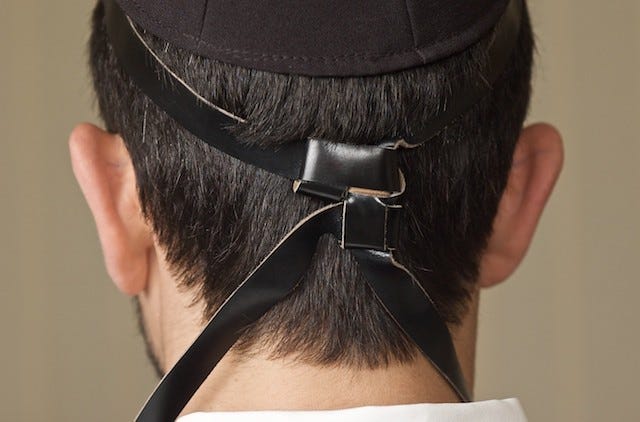
This integration of what we know in our heads into our muscle memory is symbolized by the straps of the head tefillin that form a “ד“ for “דעת“ near the brain stem and flow down from there to our belly buttons and loins, representing the merging of our wisdom with our most basic and primal faculties.
“Real intelligence” must ultimately be judged by our actions, not our published academic papers or lip service. The more educated we are, the more our actions should reflect what we’ve learned.
Da’at is where we most clearly can see that artificial intelligence is eminently useful but inescapably artificial. Models have no skin in the game. They don’t have to live up to anything they say. They don’t feel bad when they’ve hallucinated. They don’t have to defend why they gave you a different answer to your prompt than they did to me with the same prompt. They don’t have any true opinion because they don’t bear any responsibility. They can’t bear responsibility because they don’t truly exist as an entity, and therefore have no identity. They are merely models of human reasoning.
We, however, possess all of these. We have a whole lot of skin in the game. We are taken to task when we don’t live up to what we say we will. As we should. We are called out for saying one thing to one person and another thing to someone else. We are expected to form opinions, and take actions based on those opinions. For this, we bear responsibility, and through this we forge our identities.
AI can really help us, but it cannot and will not replace us. Perhaps most importantly, AI will help us come to know who we are and what we are capable of — if we are wise enough to see it.
I am not including a fourth word for intelligence in this post, which is sekhel-שכל, which refers to the computational element of intelligence, which I believe is captured largely by AI.
I went this week to visit a school called Alpha School that uses AI tutoring 2-3 hours a day in order to “give time back” to students in the form of human interaction and the cultivation of life skills. The essential idea is to let AI do what AI is good at to let humans do what humans are good at.
This is another wise aphorism by Rabbi Noach Orlowek — it’s not about distinguishing between what’s important and not important. Everything is important. But some things are more important than others. And every person bears the responsibility of making that choice constantly.
They’re not.
Through a kabbalistic lens, bina is the slow, feminine pregnancy and development of understanding that corresponds to khokhma’s sudden, masculine conception of a concept.
I refer you to this earlier post in the Language of Life series that expands on the concepts of masculinity and femininity as they are crystalized in the Hebrew language, specifically in the masculine letter yud (י) and the feminine letter hei (ה).

The Talmud teaches that one can only truly understand an idea in so far as he can get past his misconceptions about it.
Megillah 12a:
Rava said that even Daniel made a mistake in the calculation [of how long the exile will last] as it is written, “I, Daniel, have come to understand (binoti-בינותי) the books [regarding the number of years of exile]” — since he says “I have come to understand,” it must be that he made mistakes along the way.
According to Jewish law, humans are considered to possess da’at, and are therefore legally responsible after puberty, which corresponds to the age of 12 for women and 13 for men.
Nice father flex and of course another token Ivy League ("the fanciest") reference. It just wouldn't land as hard if they weren't part of the exclusive club. Have you considered that AI is actually a binah probiotic where you consistently prompt a subject in order to unpeel layers of its reality from different angles or even a binah enabler where you can get instant clarity of all primitives of some complexity and then command the AI to test you on those primitives in order to build the foundation for further metabolism? Lastly, as a slight aside it should be noted that you khokhma landed on Tony Robbins.
“Jacki” con cariño y respeto. This could arguably be one of your most structural insightful and brilliant pieces. Wow! So well explained! I would love to join a study group - online - if you have one or start one. Abrazos desde el Gran Norte!