


Sukkot has made a comeback in the 21st century. What was once considered an obscure holiday to most American Jews is now oddly familiar and cool.
Fun fact: the premier online Jewish library, Sefaria.org was co-founded by Joshua Foer thanks to a Sukkah-building competition, which got him Googling how to make a kosher Sukkah, and wondering how he could make Torah texts accessible to more people (listen to his story here at around 44:00 minutes).
This said, although the word “sukkah” now conjures up the iconic Jewish hut in the minds of many, there are other tracks of meaning running through the word “sukkah” that can change the way we experience it — but only if we can read it and understand it in its original Hebrew.
Protection:
To start, the simplest read of the word sukkah-סוכה comes from the word sochech-סוכך. The verb sochech is identical to the noun schach-סכך, which is the specific word for the organic roof of the sukkah. It means cover, screen off, and shield.1
The sukkah is a shelter, albeit a sort of flimsy shelter compared to the sturdier, permanent homes all of us are blessed to possess.
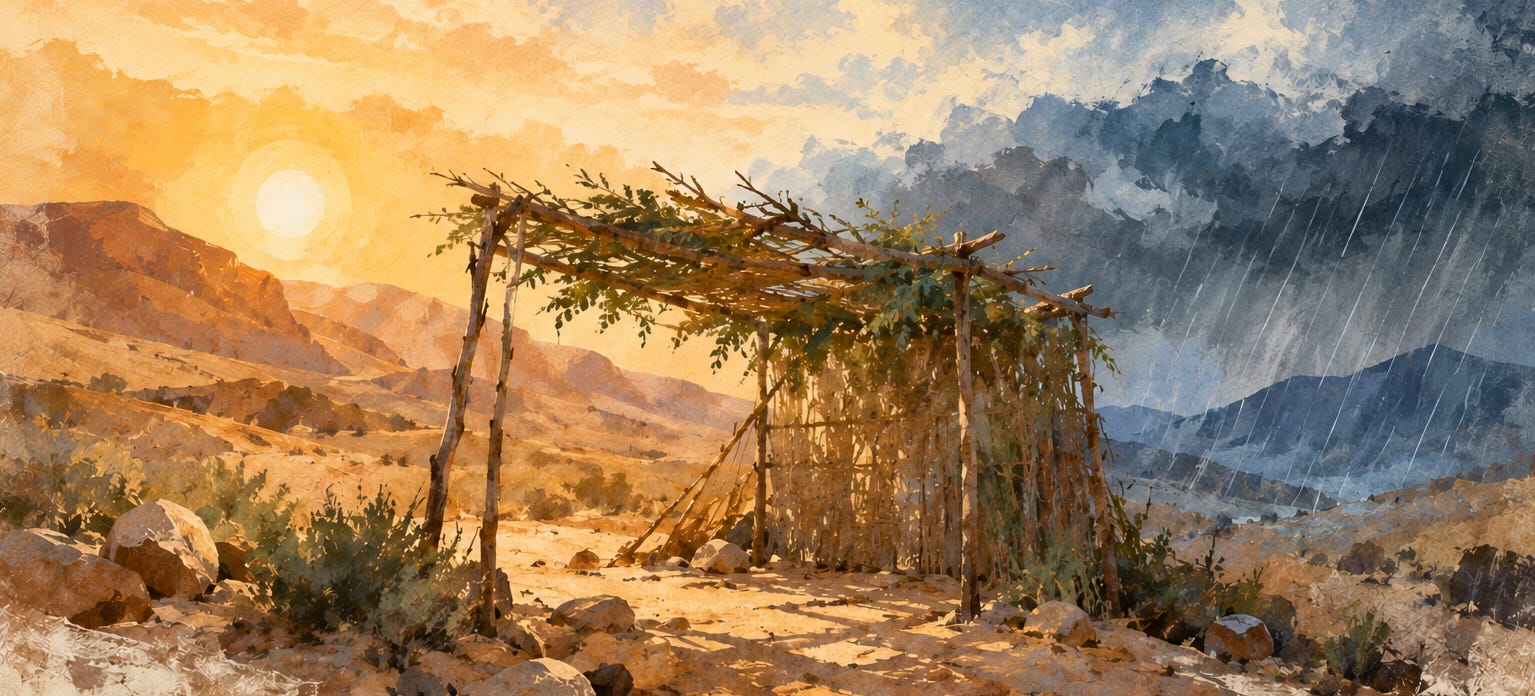
Imagine that you’re lost in the wilderness, and it’s either scorching hot or cold and starting to rain. How happy you would be to find some branches that can serve as a makeshift shelter? How your eyes would widen as you would spot them there almost waiting for you to find them, and how grateful you would be for something so basic and rudimentary, but so essential for life!
Spiritual Infrared Vision:
The next level of meaning of the word sukkah is its connection to a seemingly unrelated word socheh-סוֹכֶה. Socheh is “to see,” but different from the more common word for seeing, roeh-רואה. Socheh is “to peer” or “gaze” — to look through, and perceive beyond what meets the eye.2
Rabbeinu Bechaye (Spain, 1255–1340), in his profound work Kad HaKemach, draws the connection between the word “sukkah-סוכה” and the name with which Sarah, Abraham’s wife, our foremother, was called in her youth because of her astounding way of seeing past superficial appearances to essence of things. She was called Iska-יִסְכָּה because of her ability to be socha — to look deeper than everyone else.

When we reside in the comforts of our home, we barely see our house or possessions. Our house is so important to us, so foundational for everything, that we take it entirely for granted. But think how amazing is it that in the crisis of being lost in the wilderness, subject to the elements, our vision becomes hyper-attuned to this most basic need for shelter. And when we finally set it up, the walls and the roof, we don’t just see a bunch of sticks. We wouldn’t just see a meager shack and feel bad for ourselves. We would see through it and appreciate God’s love for us, that He allowed us to find exactly what we needed, when we needed it.
It’s exactly in this way that the holiday of Sukkot is meant to transform our vision to the point that it should change the way we perceive the blessings around us all year.
Seeing God:
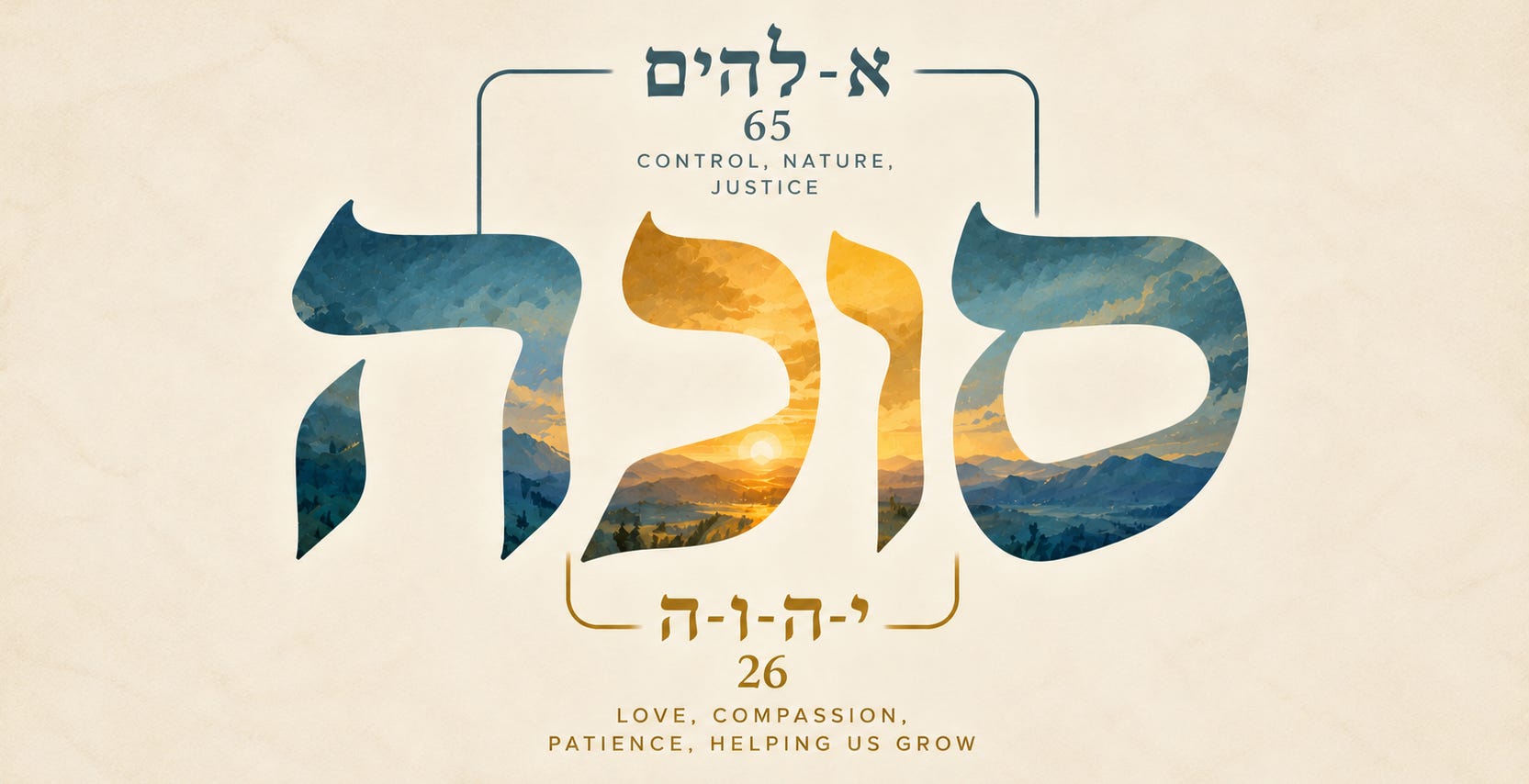
Finally, the word sukkah-סוכה can be viewed with a sort of infrared vision as a samech-ס and a hei-ה surrounding a kaf-כ and a vav-ו. Samech-Hei-סה is actually the way in Hebrew you would spell out the number 65, and Kaf-Vav-כו is the way you would spell out the number 26.
As you may know, in Hebrew, it’s not that letters have numerical equivalents. In Hebrew, Hebrew letters are numbers. Classically, in Torah books, even today, page numbers have traditionally been numbered with Hebrew letters.

What is the meaning of these two particular numbers, 65 and 26?
Well, 65-סה, is the number that represents one of God’s names, the name Elohim-אלקים, which refers to God’s control and dominion of nature. It refers to the way we often relate to life, which is that we live in a world of cause and effect, consequences, laws of nature that are unbending, and getting what you deserve.
By contrast, the number 26, perhaps more famously, refers to God’s essential Name, yud and hei and vav and hei (י-ה-ו-ה) which connotes God’s essential disposition towards us, which is one of love, patience, and a desire to help us grow, despite the challenges we face in a world that’s otherwise inflexible.
If we can make an effort to suspend our disbelief and entertain the possibility that the Hebrew language is different from other languages, then perhaps we would be open to the possibility that the word sukkah is revealing a deep secret about what the experience of spending a week in a sukkah should do for us.
By leaving our homes and being a little bit closer to nature, we also come a little bit closer to Hashem, His essential love and desire for us. By being and feeling more at the whims of the elements, of potentially being rained upon at any moment — when we don’t get rained on, or when our flimsy sukkah keeps back a drizzle or softens the beating sun, we feel blessed with the good fortune in a way we don’t often feel when we’re in the comfort of our homes.
Lastly, if we put these two numbers back together, 65+26, we get another number, 91, which again, if spelled with Hebrew letters, is tze-צא, the word which means “leave.”
Talmud Sukkah 2a:
וְרָבָא אָמַר…״בַּסּוּכּוֹת תֵּשְׁבוּ שִׁבְעַת יָמִים״. אָמְרָה תּוֹרָה: כׇּל שִׁבְעַת הַיָּמִים צֵא מִדִּירַת קֶבַע וְשֵׁב בְּדִירַת עֲרַאי.
Rave [taught that when the Torah says] “Dwell in sukkot for seven days,” it was telling us “For seven days, leave (צא) the permanent dwelling and move into a temporary dwelling.”
To change the way we see ourselves, the world around us, and the way Hashem is involved in absolutely everything, let’s leave the comfort of our homes for a week, and enter into the world of the sukkah.
Chag Sameach.

Jack
Get ready for Meaning Within, a new way to learn — launching soon.

The curtain that separates the Aron, the Holy Ark from the rest of the Temple is described as:
Shemot 40:3:
וְסַכֹּתָ֥ עַל־הָאָרֹ֖ן אֶת־הַפָּרֹֽכֶת…
…the curtain screened off and protected the Ark.
And the angelic figures that decorate the cover of the Aron itself also use the word sachach–סכך:
Shemot 24:20:
וְהָיוּ הַכְּרֻבִים פֹּרְשֵׂי כְנָפַיִם לְמַעְלָה סֹכְכִים בְּכַנְפֵיהֶם עַל־הַכַּפֹּרֶת וּפְנֵיהֶם אִישׁ אֶל־אָחִיו אֶל־הַכַּפֹּרֶת יִהְיוּ פְּנֵי הַכְּרֻבִים׃
The cherubim must have their wings spread aloft, so that their wings shield over the Cover. They must face one another, the faces of the cherubim being inclined toward the Cover.
It’s an interesting linguistic observation that the usage of the verb “sachach-סכך” is so associated with the Beit HaMikdash (Temple) and the Aron (Ark) specifically.
Like the English word for a sort of prophet, a “seer.”