


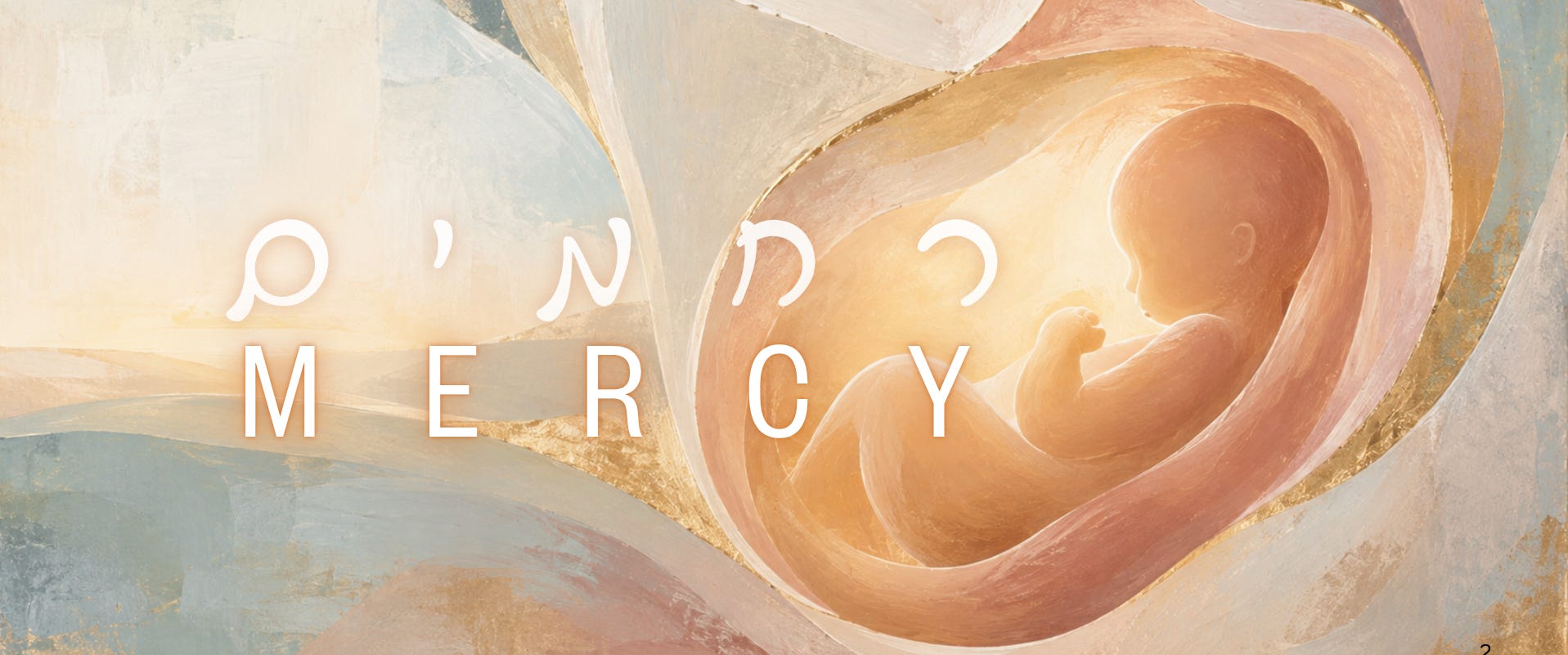
There are certain words, which are used constantly in Judaism, that are seldom used in the English language. For example, the word “mercy” is not a word I remember using all that much before I started paying more attention to Judaism as an adult.
This is, of course, aside from the childhood game, aptly called “Mercy,” which involves interlocking fingers with an opponent, and competing over who could most quickly inflict pain on the other until he squealed “mercy!” begging for the other to stop. Based on this usage, “mercy” refers to feeling bad enough for someone to cease and desist from whatever pain or difficulty you might be causing him.
The Hebrew word for mercy, rachamim-רחמים, is used throughout Torah literature, very often this time of year, a time for asking for God’s mercy:
Intro to 13 Attributes of Mercy:
…אֵל מֶלֶךְ יוֹשֵׁב עַל כִּסֵּא רַחֲמִים
God, King Who sits on the Throne of mercy*…*
13 Attributes of Mercy:
…יְ-הֹ-וָ-ה יְ-הֹ-וָ-ה אֵל רַחוּם וְחַנּוּן
Hashem | Hashem, Merciful and Gracious God…
But what is mercy, really?
Is there more to it than just “feeling bad?”
Is that what we’re asking God for — to feel bad for us?
Hebrew, as we’ve seen throughout the Language of Life Series, is a system whose Divine architecture reveals its Divine meaning. A closer look at the Hebrew word for mercy provides as vivid a metaphor as one could ask for.
The word rachamim-רחמים has as its root rechem-רחם, a mother’s womb.
True mercy is not about “feeling bad” for another per se, but rather feeling love and an inextricable connection, as one does for her own child. It is the feeling of one’s own desires enmeshed with those of the other because his existence is an an extension of her own. Maybe the English word “compassion” is a better translation:
Yishaya 49:15:
הֲתִשְׁכַּח אִשָּׁה עוּלָהּ מֵרַחֵם בֶּן־בִּטְנָהּ גַּם־אֵלֶּה תִשְׁכַּחְנָה וְאָנֹכִי לֹא אֶשְׁכָּחֵךְ׃
Can a woman forget her infant? Could she [ever] not have compassion on the child of her womb? Even if these may forget, I will not forget you [says Hashem to Israel].
The metaphor of the womb runs deeper, though.
The purpose of a womb is to grow a human being in it. It’s not to keep it there indefinitely. The baby needs to be prepared for its own “day of judgment,” otherwise known as birth, on which it must face a much bigger, colder reality that is far less amenable to it’s development than the warm, cozy space it presently finds itself in.
Rachamim, then, is not about evading reality or evading life’s consequences, but preparing us for them, with the understanding that if we face reality too soon, too fast, we won’t make it — rendering the whole process absurd. Whereas the modality of judgement demands justice hayom-היום, today, the modality of mercy says that judgment will be more fairly served tomorrow, machar-מחר (interestingly the same letters as rechem-רחם). Mercy, then, does not contradict the insistence of justice, it just asks that it be deferred to a later date when the person facing judgment will be more ready for it.
Rachamim, then, is not about evading reality or evading consequences, but preparing us for them…
In the same way: punishing a child before he has had a chance to learn a lesson, or firing an employee before he’s had a chance to learn from a mistake — while the parent or employer may believe that he is serving justice — is itself unfair. Fairness and justice actually demand mercy. They demand a process that gives the person enough time to stand in judgment on their own two feet.1
This understanding of mercy can help us better understand and appreciate what’s happening this time of year:
A question that often comes up is: Why does Rosh Hashanah come ten days before Yom Kippur? If Rosh Hashanah is the day of Judgment, and Yom Kippur is the day dedicated to teshuvah, repentance, through which we receive forgiveness and atonement, the paradigm seems inverted.
We are used to being tested at the end of a period of preparation, not the other way around. In school, studying precedes the test. At work, the employee “ups his game” before his annual review. But when it comes to Rosh Hashanah and Yom Kippur, it’s odd that we are first tested, and only then have a chance to prepare.
What is this pattern, and what does it teach us about mercy?
The pattern is actually found laced into the very fabric of reality as it’s described at the beginning of the Torah.
Love and mercy are associated with God’s essential proper name, spelled י-ה-ו-ה. Hashem’s most essential agenda is our personal flourishing. This is in contrast to His second-most-often-used-name, Elohim—א-להים, which is associated with judgment, rules, and consequences, and seems to place obstacles in the way of our flourishing.2 But, of course, the two names represent the two interacting modalities we mentioned above. He loves us (י-ה-ו-ה), and therefore He holds us to a standard that challenges us (א-להים). The challenges of life are calibrated to bring out our potential.
The creation of the universe is initially narrated using exclusively God’s name Elohim because the laws of nature are in and of themselves unbending. Gravity, if you haven’t noticed, has no mercy for those who test it.
This is why there is no mention in the first chapter of the Torah of God’s essential name, י-ה-ו-ה. It appears only after the seven days of creation are completed and the Torah begins to tell the story of creation anew, with human beings at the center of the story. And there, it appears in conjunction with and prior to the name Elohim:
Bereishit 2:4:
אֵלֶּה תוֹלְדוֹת הַשָּׁמַיִם וְהָאָרֶץ בְּהִבָּרְאָם בְּיוֹם עֲשׂוֹת יְ-הֹ-וָ-ה אֱ-לֹהִים אֶרֶץ וְשָׁמָיִם׃
These are the generations of the heaven and of the earth when they were created, in the day that Hashem Elohim made the earth and the heavens.
The sages explain this shift memorably and concisely:
Rashi on Bereishit 1:1, based on Midrash Rabbah 12:15:
Initially, it occurred to God to create the world with strict justice, but He saw that the world could not exist [under such ruthless consequences], so He put the attribute of mercy first and partnered it with the attribute of justice.
Why did God want pure justice in the first place? Didn’t He know that it wouldn’t work on its own?
God’s “initial thought” reflects His ideal desire. Challenges and consequences to our actions are good. They bring out our best. An athlete who wants to become world-class needs a coach who is relentless. A professional who wants to achieve excellence needs the high standards and accountability of a great manager. God ideally wants us to be pushed to our full potentials.
But without room to make mistakes, learn from them, pivot, and try again, there is no point in even trying.
That is where mercy, rachamim, comes in. The purpose of rachamim is not to cancel the strict standards of justice, but rather to stretch, delay, and diminish its consequences long enough for us to grow through them.3
If we were to live in a world without consequences, our lives would be of no consequence. God, in His care for us and His commitment to our growth and development, wants us to face judgment. Rachamim doesn’t contradict this. It merely creates the space and time for us to develop to the point that we’ll be ready for it.4
A womb.
And yet, at the edge of every womb is the moment of birth. It’s where the rubber hits the road. The moment of truth.
Rosh Hashanah, as the machzor says, is the day of harat olam-הרת עולם, the conception of the world.
We’re not supposed to be ready for Rosh Hashanah.
People ask each other every year, “Are you ready for Rosh Hashanah?” The honest answer is “no.” No one’s ever ready for Rosh Hashanah. Rosh Hashanah is the shock to the system of knowing that judgment — birth — is coming. Without that shock, we don’t even start to get ready.
The period between Rosh Hashanah and Yom Kippur is that period of mercy in which we have to get moving, get going, and get our acts together. And the day that we’re supposed to fully absorb just how profound God’s mercy and love for us is, is Yom Kippur.
Mercy is not, as I had thought, just begging for the consequences I’d earned to be lifted. It’s not a get-out-of-jail-free card. True mercy, rachamim is the chance for me to get ready — a chance for me to actually get myself out of the hole I’ve dug myself into.
Note the otherwise incomprehensible line from Psalms:
Tehillim 130:4:
כִּי־עִמְּךָ הַסְּלִיחָה לְמַעַן תִּוָּרֵא׃
With You, God, is forgiveness, so that we can revere You.
It sounds like nonsense. Because God forgives us, that’s why we revere and fear Him? How does that make sense? If someone is forgiving, looks the other way, and doesn’t actually act on your mistakes, that should make you fear him less.
But with our newfound understanding of mercy, it makes sense.
What gives a person true reverence is not the feeling that punishment is coming, that no deed goes unpunished, and that there’s nothing we can do about it. That produces resignation. Maybe fear of punishment, but not reverence.
Reverence comes from being given the space to grow precisely because something real is eventually going to be demanded of you. The challenges each of us face are calibrated for us. That’s truly scary because success is frighteningly within reach.
The mercy of begging the other to stop twisting our wrists isn’t it. True mercy is asking for the space we need to succeed in the challenges that will make us into the people we know we are capable of becoming.
Rachamim-רחמים is the space, the womb, the rechem-רחם that we ask to stay in, for just a bit more time — until tomorrow, machar-מחר — to be ready.
Gmar chatima tova,

Jack
Rachamim-רחמים is plural to convey that Hashem’s mercy is far greater than His justice since it comes from a deeper place (see Maharal and Kad Hakemach by Rabbeinu Bechaye on Rosh Hashana). I have a hunch to say that it also represent the continual process of growth, as if to say the “wombs” of life that one moves through, each one serving as a process of gestation for the next.
You see in Shemot 21:6 that the word elohim-אלהים can mean literally “judges” or “court.” The Code of Jewish Law (Orach Chaim 5:1) instructs us to have in mind that God is the “Master of All Powers” when we use the name Elohim. Obviously, “Hashem is One,” but while the nuance of the name Hashem (י-ה-ו-ה) refers to His love for us, the nuance of the name Elohim (א-להים) is His absolute, all-encompassing power over us which is meted out with perfect justice.
See Rav Moshe Chaim Luzzatto’s treatment of the intertwined relationship between Rachamim and Din (justice) in Mesilat Yesharim Chapter 4.
Rabbi David Aaron once described God’s Name יְ-הֹ-וָ-ה to me as the “matrix” in which we exist. I remember thinking at the time that the word sounds a lot like the word “matriarch,” as in “mother,” which of course is associated with “womb,” and rachamim. It turned out that my intuition was correct. The mathematician JJ Sylvester borrowed the word “matrix” from its original usage referring to a womb to describe an ordered set of terms — a mathematical space. The 1999 movie The Matrix, made the notion of our existing in some generated space more vivid.