



The essential Jewish mantra is not a prayer, but a meditation.1
Once in the morning. Once in the evening. Once before we go to sleep. Once before we pass on to the next world. Whenever we feel in danger.
We recite the words, with eyes closed:
שמע ישראל ה׳ א-להינו ה׳ אחד
Shema Yisrael, Adonai Eloheinu, Adonai Echad.
Listen, Israel: Hashem is our God. Hashem is One.
In past XL posts, we’ve studied the meaning of these consequential six words. Today, I just want to focus on the first one: שמע — shema.
Ostensibly, it means “hear” or “listen.”
But as we’ve said repeatedly in our Language of Life series, translating between any two languages—and certainly translating God’s language into a human language — is like flattening a flower between the pages of a book, to borrow an analogy from Abraham Joshua Heschel. You preserve something of it, but so much is lost in the process.
In English, the verb “to hear” means to audibly perceive sounds. “To listen” implies added focus and intention to truly hear those sounds — and perhaps even carries a connotation of obeying — as in, “you listen to me, young man.”
In principle, if you hear something once, it should be enough. So why must we repeat it several times every day?
Why is part of the mantra itself the injunction to “listen?”
And why is it that after 120 years, on our deathbeds, the last thing we ask of ourselves is to listen?
I want to share three additional tracks of meaning in the Hebrew word Shema beyond what we normally hear in the words “hear” and “listen.”
1. The first track is to discern — to hone in on the sound within the noise.
Rabbi Aryeh Kaplan, in his beautiful contemporary work Jewish Meditation, explains an ancient mystical understanding of how the individual letters of the word שמע harmonize to produce its meaning.
Sefer Yetzirah, attributed to our ancestor and national founder Abraham, and generally understood to be the oldest extant work of Kabbalah, teaches that the letter ש (shin) makes a “shhhhh” noise like the chaotic sound of radio static.
It is not a coincidence that shin is also the defining sound of the Hebrew word for fire, אש (eish). Fire is the thermal version of radio static: air molecules vibrating violently, with no rhyme or reason.
Its diametric opposite is the second letter, מ (mem), which sounds unmistakably like the Hebrew word for water, מים (mayim). Similarly, the sound produced by an extended memmmm is a smooth, constant hummmm.2
One can immediately sense the contrast between these two sounds by seeing their waveforms next to each other. In fact, the first even looks somewhat like fire, while the second looks like waves on water.
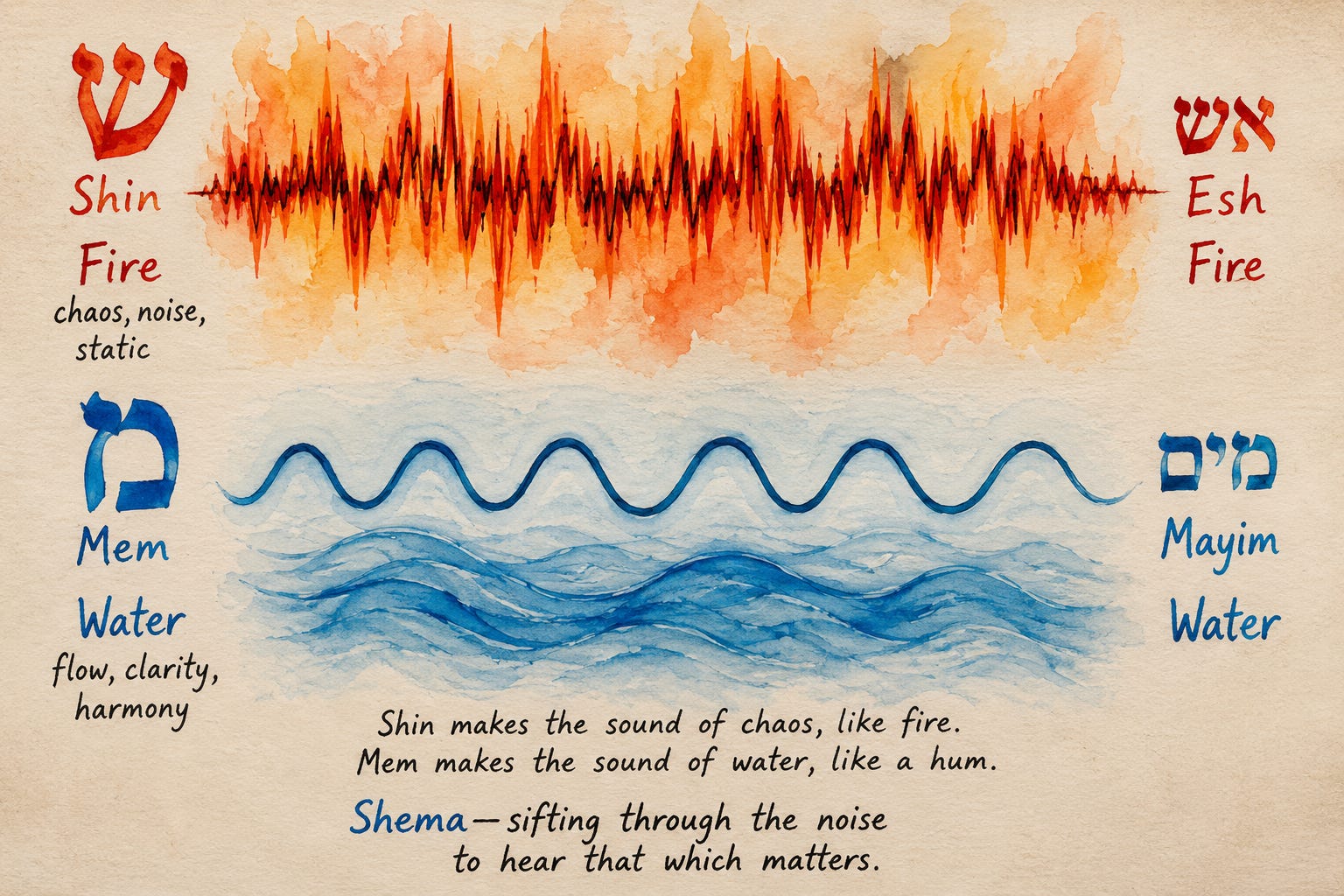
Rabbi Kaplan explains that listening isn’t just hearing the sounds, or even making an effort to hear the sounds — both of which are certainly part of listening, but just the beginning.
שמיעה (shmiya), true listening, requires mentally sifting through the static and noise to discern the frequency that one is trying to tune his mind to.
Someone once explained to me that although there is a nonverbal benefit to taking someone aside to have a one-on-one conversation in a quieter place, neurologically, when people speak in a louder, busier space, both brains have to fire more intensely and listen more intently. Once both parties get past the distractions, they lock into an even more deeply connected, attentive state than they would otherwise.
The third and final letter of the word shema-שמע is ע (ayin-עין), which means “eye,” but more precisely connotes looking deeply. For example, in-depth Torah study is called עיון (iyun), and a wellspring that draws water from the depths is called a מעיין (ma’ayan) or עין (ein, think Ein Gedi). After one has tuned into the channel he was looking for, he must go deep to truly listen, which leads us to the second additional track of meaning:
2. Understanding.
It’s clear from the Oral Tradition recorded in the Talmud that Torah sages have always understood that the word Shema means not just to hear sounds, and not even just to discern them through the noise, but to understand the message being communicated.
Talmud Bavli, Berachot 13a:
חֲכָמִים אוֹמְרִים: בְּכָל לָשׁוֹן…אָמַר קְרָא: ״שְׁמַע״ — בְּכָל לָשׁוֹן שֶׁאַתָּה שׁוֹמֵעַ
the Rabbis say: Shema may be recited in any language you understand…The verse states: “Hear, Israel” therefore, one may recite Shema in any language that you can hear and understand.
If you think about it, this isn’t just a quirk of Hebrew semantics. It’s an extension of what listening actually is.
If a person is traveling in a foreign country and sits in a café, he may be hearing dozens of conversations around him. He may even focus his attention on one of them and successfully make out the sounds. But if he can’t hear the meaning within those sounds, he isn’t really hearing in any meaningful sense at all. It’s all background noise.3
When the little bones and tiny hairs in our inner ear vibrate, we perceive vibrations in the air. But only when we understand the meaning encoded in those vibrations are we listening with our minds.
Human beings speak not merely to get another person’s attention and be heard, but to be understood.
It’s for this reason that the sages of the Talmud rule that one can fulfill the mitzvah of reciting the Shema in any language he understands — with the caveat that he actually understands it. Moreover, when reciting it in Hebrew, certainly that first line which explicitly urges us to listen, the one reciting it must understand the meaning of the words in order to fulfill his obligation.
True listening demands understanding.
And one can always understand more deeply than he understood last time.
It’s for this reason that the second paragraph of the Shema tells us:
וְהָיָה אִם שָׁמֹעַ תִּשְׁמְעוּ אֶל מִצְוֹתַי לְאַהֲבָה אֶת ה׳ אֱ-לֹהיכֶם וּלְעָבְדוֹ בְּכָל לְבַבְכֶם וּבְכָל נַפְשְׁכֶם
“…im shamoa tishme’u…l’ahava et Hashem…”
If you listen and keep listening…to love Hashem.
It’s quite clear that what is being asked for is not mere obedience and mechanical observance. Just the opposite. Here the point is to fulfill the mitzvot out of love, and to come to love even more deeply through their fulfillment.
How?
Through ever-deepening understanding.
Hence the unusual double phrasing: אִם שָׁמֹעַ תִּשְׁמעו — im shamoa tishme’u.
The Talmud plays on precisely this repetition:
אִם שָׁמוֹעַ — תִּשְׁמַע. וְאִם לָאו — לֹא תִּשְׁמַע. דָּבָר אַחֵר: אִם שָׁמוֹעַ — בְּיָשָׁן, תִּשְׁמַע — בְּחָדָש
“If you listen”—then “you will listen.” And if not, you will not listen.
Another interpretation: if you listen to the old [if you return to and review what you have already learned] then you will be able to listen to the new.
The paradox is beautiful. We tend to think that once we have heard something, we are finished with it. I heard that already. Old news. I know that.
The Talmud suggests the reverse.
If you really heard it, really tuned into its meaning, you’ll hear even more the next time.
And this leads to the third, and deepest, track of meaning in the word Shema:
3. To accept upon oneself that which he has heard and understood.
One can certainly get married, for instance, and say the words:
הרי את מקודשת לי בטבעת זו כדת משה וישראל
“Behold, you are sacred to me through this ring according to the law of Moshe and Israel.”
And yet, in saying those words, not fully accept upon himself the entire gamut of responsibility that marriage entails—physically, emotionally, financially.
Perhaps this is why it has become popular to renew one’s vows some time after the original marriage ceremony.
Why would people feel the need to renew his vows? They’ve already proclaimed them. Was there something wrong with them the first time?
No.
But when they uttered those words, they were young and somewhat dumb. Even thought they likely understood what they were saying, how deeply did they accept it upon themselves?
This is why we repeat the Shema multiple times a day, and at spiritual junctures in which we have to take stock of our lives in their entirety.
There’s a lot of noise in the world, and the exercise of honing in on that which is most important is not a trivial recitation of some ancient words for good luck.
Additionally, to whatever degree we understood last night what life is about — the One that runs through everything — we can certainly try to understand it better this morning, and even better tonight.
And lastly, whatever it is that we understood, the true test of our understanding is not in our minds. It should become apparent in the way we live our lives.
If we truly understood what we’re looking for, how could that understanding not define us through and through?
This is what it means to listen.
And perhaps this helps us hear more clearly, and more deeply, words in this week’s parsha that we might otherwise have glossed over:
Devarim 28:1:
…וְהָיָה אִם־שָׁמוֹעַ תִּשְׁמַע בְּקוֹל ה׳ אֱלֹקיךָ לִשְׁמֹר לַעֲשׂוֹת אֶת־כׇּל־מִצְוֺתָיו אֲשֶׁר אָנֹכִי מְצַוְּךָ הַיּוֹם…
“And it will be, if you listen and keep listening to the voice of Hashem your God, to observe and do all of His commandments that I command you today…”
And then:
28:2:
וּבָאוּ עָלֶיךָ כָּל־הַבְּרָכוֹת הָאֵלֶּה וְהִשִּׂיגֻךָ כִּי תִשְׁמַע בְּקוֹל ה׳ אֱלֹקיךָ
“All these blessings will come upon you and overtake you, if you listen to the voice of Hashem your God.”
If you listen.
If you sift through the noise.
If you understand.
If you accept what you have understood deeply enough that it begins to shape the way you live.
And then tomorrow morning, we close our eyes and do it all over again.
The Shema is particularly the refrain we return to this time of year, but so is the sounding of the shofar.
Perhaps the mitzvah of hearing the shofar — לשמוע קול שופר — is practice listening to the simplest of sounds, so we can listen to all of the messages in our lives waiting to be heard.
If it were a prayer, it would read “Listen, God…” Given that we’re part of the nation of Israel, when we say, “Listen, Israel…” we’re talking to ourselves.
It’s worth noting that the sound of the mem is reminiscent of the traditional sound “om” that is ubiquitous in Hindu, Buddhist and Jain meditation.
This is why it can be distracting to have subtitles on movies when you understand the spoken language, but not when you don’t, and why too much text on slides distract one from what the presenter is verbally trying to communicate (see this article by neuroscientist Jared Cooney Horvath phD).
Jacki, esto es brillante! De un nivel excepcional. Maybe it’s simple to you, but simple is very hard to achieve and master. To communicate the way you do is hard work and a gift! Bravo! Hazak u Baruch.