


We’ve seen many times already in the Language of Life Series:
A whole lot gets lost in translation.
Words get flattened when they’re transposed from one language to another. When they are moved from one cultural context to a different one, their meaning inevitably changes. We’ve made the argument that Hebrew especially suffers from translation because its source is so Divinely rich in meaning.1
There are two other phenomena that take place even within a language itself: semantic “drift” and semantic “erosion.”
Words can drift in meaning over time. Take the word “nice,” for example. It sounds lovely to the 21st-century ear to call someone “nice,” but 800 years ago, it would have been an insult.2 Language, as a system of agreed-upon sounds and symbols, has a life of its own. It evolves as people use it, and there’s nothing inherently wrong with that.
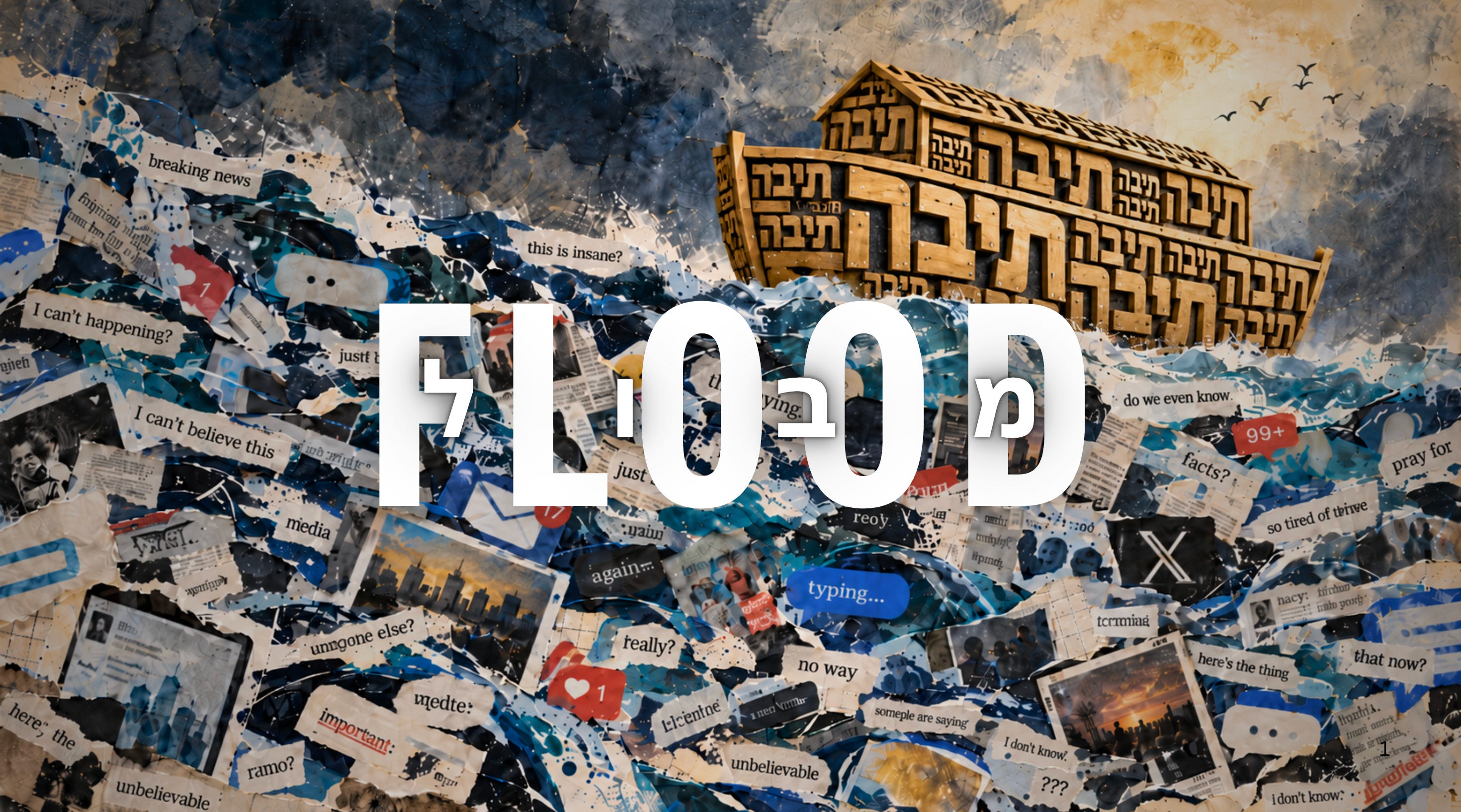
But what happens when technology dramatically accelerates the pace and volume of our communication? Our hypermodern times have brought an unprecedented flood of information and language. A 2009 study at UC San Diego estimated that between 1980 and 2008, the average American’s daily “word diet” increased by a factor of 2.5. With the rise of social media and ever-increasing screen time, that figure has presumably climbed even higher. Yet as the volume of language we consume grows, the depth of our engagement with it often diminishes. Much of what we consume today is fragmented and fast-paced—listened to at 1.5x or 2x speed, and when “read,” more likely scanned than studied.3 Meanwhile, the language itself seems to evolve at a dizzying pace. Talk to a teenager today, and you may feel that you speak a different language altogether.
Things become more complicated when words carry moral weight.
Consider words like “theft,” “marriage,” “truth,” or “morality.” These aren’t mere social conventions. They refer to concepts that inform how we understand ourselves, our relationships, and our obligations to one another. Their definitions define our lives and our world. As their meaning shifts, the ground beneath our feet can feel like it’s eroding.
Let’s start with a more innocuous example: It’s not uncommon to hear someone use the word “steal” when asking to take something from another person.
“Do you mind if I steal a potato chip?”
In reality, they’re not stealing. They’re asking for permission.
Alternatively, people may use the word “borrow” when they have no intention of returning the item.
“Can I borrow a piece of paper?”
My point here is not that we should be up in arms when people say either of these. But words carry notions, and when we become accustomed to using them in ways that blur the distinctions they were meant to preserve, we risk blurring those distinctions in our own minds as well.
After all, how we speak about something inevitably influences how we think about it. And how we think about it influences how we behave.
And unless we periodically refresh our understanding of the words we use, we risk experiencing a sort of semantic erosion. What begins as a linguistic degradation can become a conceptual degradation, and eventually, a moral one.
Let’s look at an example that is more consequential: marriage.
Classically, marriage has an element of exclusivity and lifelong commitment baked into it — certainly in the Jewish conception of it. Otherwise, what exactly changes at the point of marriage?
Then there's a modern term that, even if we don't subscribe to it, can slowly seep into our consciousness: “open marriage.” How can the word “open,” meaning “non-exclusive” modify the word “marriage” that is intrinsically exclusive? By accepting that combination of words, have we not also blurred the clarity of the word “marriage” itself?
Words aren’t merely sounds we use to communicate ideas already formed in our minds. They help give those ideas form in the first place. Language gives shape to experience. And because language is shared, the words through which we organize our individual experiences become the building blocks of our collective understanding of reality.
In other words, words do more than communicate meaning. They preserve distinctions. Between right and wrong. Between mine and yours. Between one kind of relationship and another. And when those distinctions begin to dissolve, something much larger than language is at stake.
A Container for Language and its Values
In Parshat Noach, the Torah presents two extraordinary episodes involving the breakdown of the structures that make civilization possible.
The first is the Mabul (מבול), the Flood, and the Teiva (תיבה), the ark—or, more literally, the container—that is its remedy.
The second is Migdal Bavel (מגדל בבל), the Tower of Babel, where humanity’s unified language breaks down, leaving people unable to communicate with one another.
(The story of Babel deserves an exploration of its own, which we’ll save for next week.)
Rashi explains that the word Mabul (מבול) relates to Balah (בלה), wearing away, Bilbul (בלבול), confusion, and Hovil (הוביל), carry away.
Water, ordinarily a source of life, became the force that eroded the structures of civilization, dissolved the boundaries between things, and stirred everything up. Language, normally a source of connection, can also become an agent of dissolution.
And yet, in the middle of this chaos, God instructed Noach to build a Teiva (תיבה). The word “teiva” means simply a container or box. But it is also the Hebrew word for a “word.”
What’s the connection between a container and a word? A box keeps out what doesn’t belong, but it also contains what’s within it, preserving its identity.
Words are meant to do precisely the same thing. A word gives an idea a recognizable form, distinguishing it from other ideas so that it can be contemplated, preserved, and communicated.
The Mabul dissolved boundaries. The Teiva was meant to preserve them.
The Torah prescribes very specific dimensions for the Teiva: 30 cubits tall, 300 long, and 50 wide (a cubit is about a foot and a half). These measurements are so specific. We have to ask ourselves what we’re meant to do with such trivia.
Assuming we’re not going to be asked to build a flood-ready ark anytime soon, these numbers are ostensibly not very useful to us. But there is a fascinating allusion hidden within them. In gematria, the numerical equivalencies of Hebrew letters:
The letter ל equals 30.
The letter ש equals 300.
The letter נ equals 50.
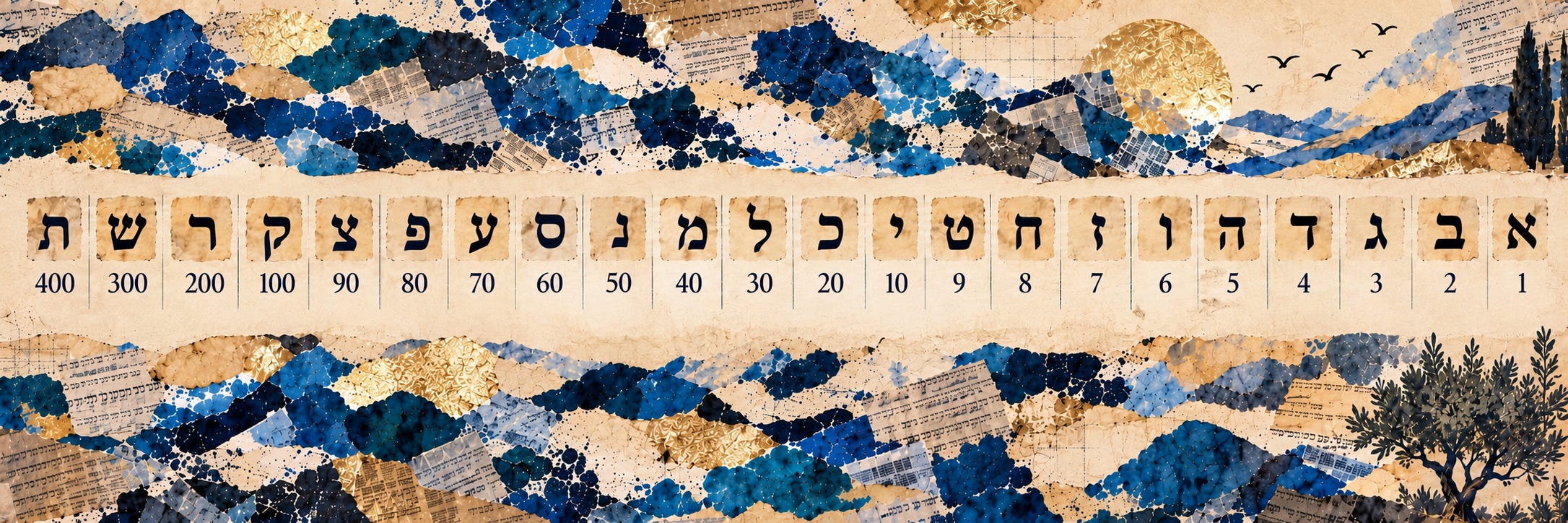
Together, they spell לשן—the three principal consonants of “lashon,” language.4
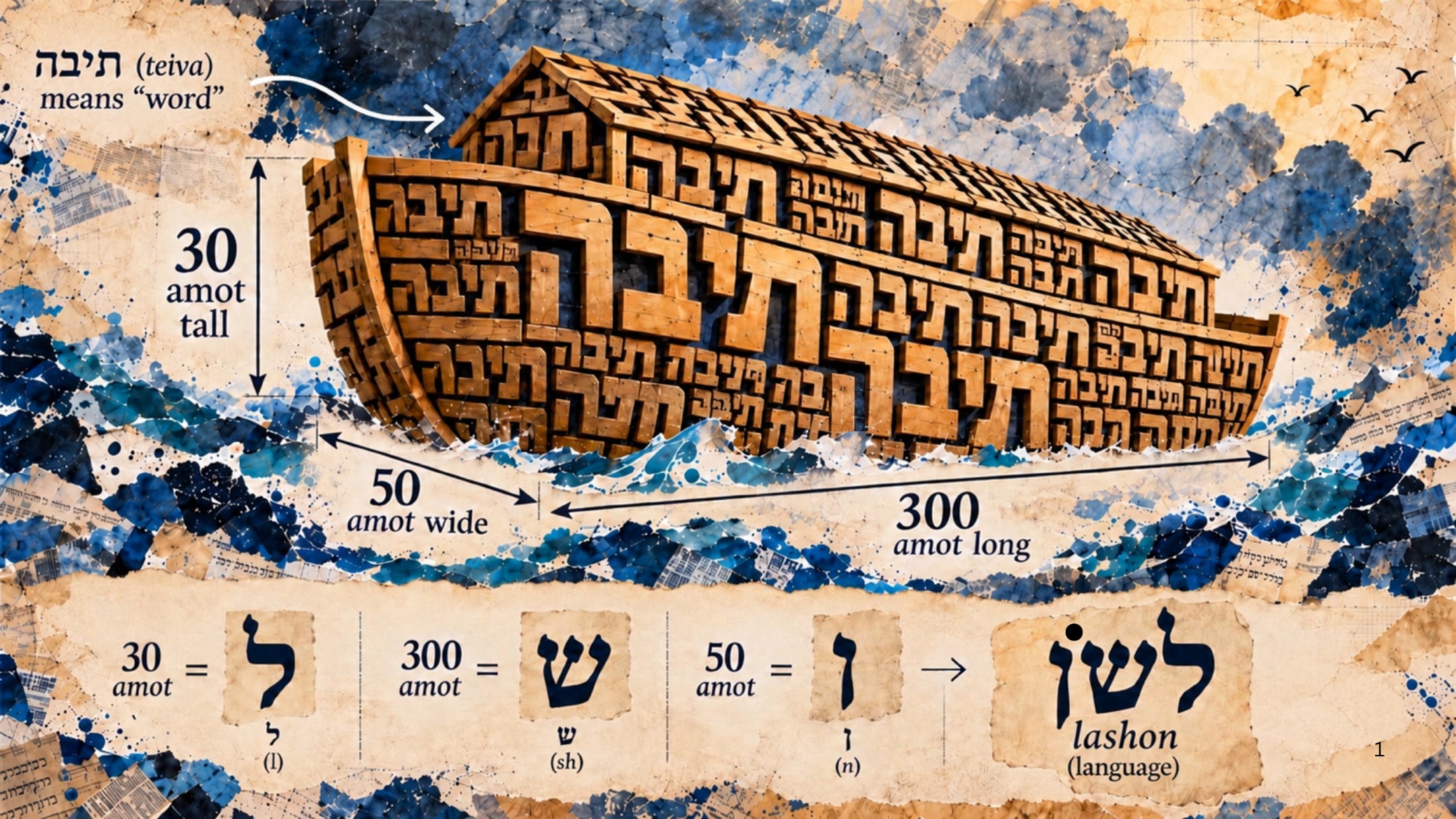
As if the ark was preserving not only the physical bodies of the humans and animals it carried, but something else entirely: the language through which those humans understood their world. And with it, the notions, distinctions, and meanings through which they made sense of reality, what we traditionally refer to as “Lashon HaKodesh,” the language of the sacred.
Unlike ordinary languages, whose meanings develop through social consensus, Lashon HaKodesh, a language given by God Himself, is traditionally understood as a language whose words express objective truths about the reality they describe.
What was being preserved was not a dictionary, but something deeper: the notions, the values, the understanding of reality necessary to recreate human society on the other side of the Flood in a way aligned with God’s will and wisdom.
Every species was to be preserved in compartments according to its identity. The animals entered male and female, each according to its kind.
The world outside had become morally corrupted. “ותשחת הארץ” — the earth had become corrupted — and “ותמלא הארץ חמס” — the earth was filled with lawlessness.
Noach, however, was an “איש צדיק,” a righteous man. He had preserved in his heart, mind and actions a moral universe in which distinctions still mattered. Where one person’s property was not another’s to take, where wrongdoing couldn’t simply be justified because someone else had done it first.
The living creatures necessary to repopulate the earth, together with the conceptual and moral foundations necessary to rebuild civilization.
Every Home Is a Teiva
Every person’s home, in a sense, is also a sort of Teiva.
Every family carries within it a particular understanding of the world. Of what constitutes love, marriage, loyalty, generosity, honesty, and respect.
And every family has to do some work of preserving those meanings. The values they live by, the boundaries they establish, the behaviors they don’t tolerate, and even the language they choose to use.
I grew up with family friends of my parents who refused to watch any movie in which there was marital infidelity. They knew that cheating was part of the world. They simply didn’t want that part of the world to infiltrate their home. What we watch and listen to changes us.
Similarly, a friend of mine has his own personal custom that whenever he hears about somebody he knows getting divorced, he does something nice for his wife that day. He’s concerned that the prevalence of the word “divorce” on his lips might gradually compromise his own notion of marriage and its sacred stability.
Both are ways of preserving the world of meaning that a home contains. Of making sure that the words through which we understand our most important relationships don't gradually lose the substance they were meant to carry.
One family chooses what not to let in. The other responds to something encountered outside by reaffirming what matters inside. Both are ways of preserving the world of meaning that a home contains.
Entering and Leaving the Teiva
We can’t live our entire lives inside the Teiva.
We have to go out, interact with other people, encounter different perspectives, and engage with a world that doesn’t necessarily conform to our own notions of things.
But we also have to return to the Teiva.
The Baal Shem Tov seizes on the dual meaning of “Teiva” in his interpretation of Hashem’s command to Noach:
Bereishit 7:1:
בוא אל התיבה.
Come into the ark.
Enter the word.
We ordinarily think of words as things that come out of us. We formulate an idea in our minds and then express it in words. Spit them out like an AI chatbot.
But the Baal Shem Tov is inviting us to reverse that relationship. Instead of simply producing words, we can enter them. We can contemplate them, immerse ourselves in them, and allow the meanings they contain to shape our consciousness.
Think of how many times we’ve said “Baruch” without stopping to consider what a blessing is. How many times we’ve said “Echad” without contemplating what it means for Hashem to be One. Or how often we’ve said “Modim” without experiencing gratitude.
We may have the definitions clear, but how often do we actually enter them?
In a world so full of words as ours, we must enter deeply into the words of Torah and Tefillah to contemplate their meaning, and experience what they contain.
We have to go out into the world, but we also have to keep coming back into the Teiva, so that the words through which we understand our world don’t become empty vessels.
The Language of Life
And in a sense, these two dimensions of the Teiva are precisely the two primary goals of this Language of Life series.
The first is to crystallize the definitions of Hebrew words, which in turn crystallizes our understanding of the dimensions of life that those words refer to.
But the second dimension is to actually experience learning and teaching Torah in this way. And that’s what we’re trying to accomplish here. To discover the meaning contained within the words of Lashon HaKodesh, and to enter those words deeply enough that their meaning becomes part of the way we experience life.
We began with the modern flood of language. Messages, articles, opinions, conversations, posts, notifications. An endless stream of words, many of them consumed almost without thought. And perhaps the greatest danger isn’t merely that their meanings change, but that we’re moving too quickly to experience those meanings at all.
We can spend an entire day surrounded by words of Torah and barely allow any of them to penetrate us.
Water, water everywhere and not a drop to drink.
We need the Teiva to preserve the meanings through which we understand our world. But we also need to enter those meanings, to allow them to shape the way we think, feel and live.
So in a world flooded with words, perhaps the most important thing we can sometimes do is simply to enter one.
בוא אל התיבה.
Enter the word.
According to the Talmud (Megillah 9a), one of the reasons for the institution of the Fast of the 10th of Tevet was the translation of the Torah into Greek in 246 BCE.
Neuroscientist Dr. Jared Cooney Horvath recently testified in front of Congress claiming that the College Board’s move from average reading comprehension passage length on the SATs changing from 500-750 words to 25-150 words represents a move that is kowtowing to reading trends among youth that will only continue.
Tiferet Yehonatan, Bereishit 6:15; Avodat Yisrael, Noach, citing the Maggid of Mezritch.