


Last week, we learned that the word “Torah” means guidance, the instruction we need for life.

Torah is the all-encompassing word for God’s guidance to humanity, most notably through the Torah given to the Jewish people. But there is another word used specifically for the five books of Moses, which Jews around the globe completed just this last weekend on Simchat Torah, and began again as soon as we finished.
That word is Chumash-חומש.
Chumash, very clearly, has something to do with the word chamesh-חמש, meaning “five,” (as in: echad, shnayim, shalosh, arba, chamesh).
The question is: Why is the number of volumes in the core text of the Written Torah so important that it seems to define it?
Asked differently: Why is the Chumash divided into volumes at all?
After all, in its entirety, it possesses about half the number of words (<80,000) as the average Harry Potter book (~160,000).
Since the Torah is a book of instruction, it naturally also instructs us on how best to give instruction.
One of the most important principles of teaching is to teach first things first and second things second. Spewing out information is not helpful, because learning is not just about content. It is as much about structure as it is about content. Context as much as the text itself.
The Torah starts with the most all-encompassing perspective, on the scale of the universe.
It zooms into the human condition in the story of Adam and Chava.
With Noach, it zooms into the specific struggle of being an individual swimming against the current of human society.
“Jewishness,” in this context, is a sub-concept nested under being human, because all Jews are first human. Guidance about Jewishness itself begins with Avraham.1
Since Avraham chose to be “Jewish,” the next concept is the challenges and assets of being born Jewish. This is taught through the life of his son Yitzhak next...
Every sub-concept branches out of the concept that precedes it conceptually like a tree or fractal.
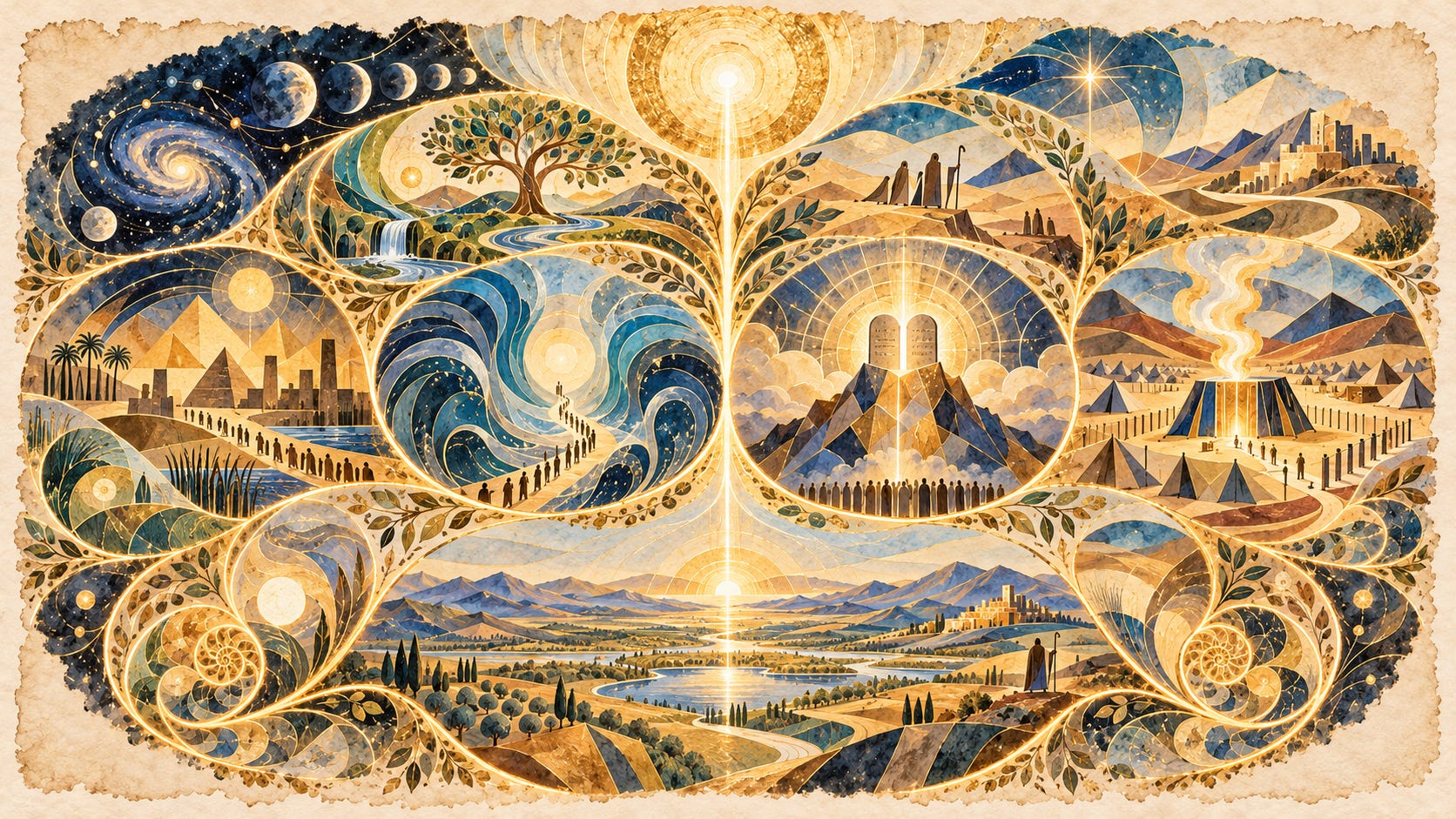
What emerges from this structure is something extraordinarily helpful. If you want to understand the meaning of a concept, go to its first appearance in the Torah.2
The first appearance is the 1.0 version of the concept. Later appearances are the 2.0, 3.0, 4.0 iterations.
Let’s put this idea to work: Where does the Torah talk about creation?
Naturally, one would answer: the first chapter of the book of Bereishit, which describes the creation of the universe.
This is true, but you can also look at the whole book of Bereishit as describing the creation of what will become the Jewish people that will be tasked with the creative mission of bringing humanity to its moral maturity.3
On the other hand, if we go back to those seven days at the beginning of the book and want to study the “DNA structure” of the creative process, we need to look closely at the first thing created.
The first thing whose creation the Torah describes is light.4
We may have expected a more magical, even Godly, poof! — God snapped His fingers, made light, and moved on to the next thing, but no. This first creation unfolds through a step-by-step process. While God certainly could have made it instantly, He chose to slow down His process so that it serves as Torah, instruction for us.
First, God says, “There will be light.” Interesting in itself because it could have just skipped to the light coming into existence. It’s as if the Torah is showing us God entering the prompt into the AI, to use a modern metaphor.
Then, there is light.
The first two stages of any creative process are conception and manifestation.
Conception is the formation of the idea in the mind, the intent to create.5 For humans, this is perhaps the most mysterious stage. This stage strikes like lightning, almost always when we least expect it — in the shower, on a run, or just messing around on a guitar.

And then, stage two: manifestation, when one allows what would have remained “just an idea” to run all the way from his mind through to his fingertips until it becomes real and manifest.
“Let there be light.” There is Light.
But the Torah doesn’t stop there, even though one might think that this is the creative process: you have ideas, and you make them happen. But we’re only 40% there.
Next, the Torah surprisingly describes that “God saw the light, and it was good.”
We may not appreciate this as a stage in the creative process because an artist doesn’t seem to be creating at all when she is looking at what she has created.
But think of a painter stepping back from her painting. She tries to look at it with fresh eyes, to take it all in. This is a critical stage in the creative process. While creating, the creator is so enmeshed in her creation that she can’t yet see if it is good.
For us learning the Chumash, this raises a question: Why would God have to do that? Isn’t it certainly good if God made it?
Which brings us to the fourth stage that is the continuation of the sentence that started with God “seeing the light”:
The first question is: If it ain’t broke, why fix it? If you just said it was good, why are you messing with it?
Secondly, what does it mean to separate light and darkness? Isn’t one just the lack of the other?
Rashi, the great commentator on the Chumash, asks this question and answers by invoking a midrashic teaching from the Talmud.6
Rabbi Elazar in the Talmud taught that God saw that the light of creation, which revealed the unity and secrets of all things, would be misused in the future by bad people. And so He concealed it for the righteous.
While this raises questions of its own, it helps answer some of the ones we’ve already accumulated.
The light was good. And because it was good, if it fell into the wrong hands — people with their own agendas for it — it would become very bad.
The truth is that truth itself can become a weapon to spread falsehood in the hands of those willing to use it toward that end.
The light was good — Divinely good — but the users who would come to use it were not yet good, and so the light had to be concealed for the greater good.
This is the stage called user modification.
After assessment, the creator has to tweak her creation. Although creativity begins as a personal, spiritual act in and of itself, ultimately one wants it to reach another and be meaningful for them. This adjustment is therefore a vital step of editing in the creative process.
A creator might make a new app and, after creating a prototype, say: “This is amazing. There’s so much functionality. Look how much you can do with it.”
But creators tend to initially overcreate — to create more than can be received.
The critical fourth stage is to simplify the product for the one who will use and enjoy it.
Finally, the Torah describes a fifth stage:
“And God called the light ‘day.’”
Light is wonderful, but without a name, the user who has not yet put it to use doesn’t know what he’s meant to do with it.
A product doesn’t speak for itself without branding. Creators know their products because they created them. But how do they get someone who doesn’t yet know their product to appreciate them enough to use them?
Branding.
A brand has to convey what has been created in a way that is graspable. This is the fifth and final stage of the creative process.
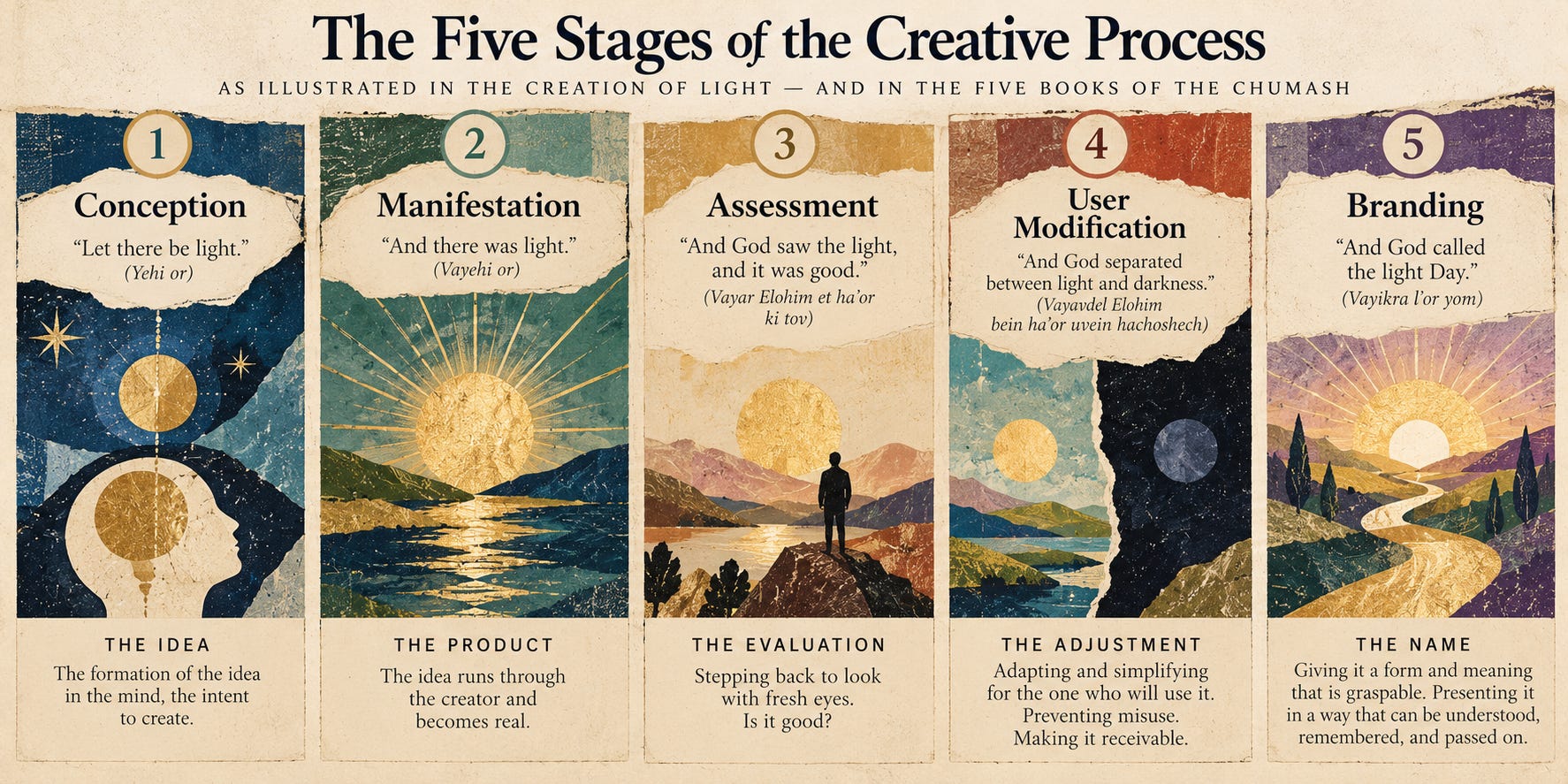
By now, you might have a sense of where we’re going. There is a remarkable Midrash in Bereishit Rabbah that notes that light is mentioned five times in the opening verses of the Torah, corresponding to the five books of the Chumash. And these five references to light, I would suggest, reveal five stages in the creative process of the Jewish nation.7
The book of Bereishit is the conception of the Jewish nation.
There is no nation even at the end of Bereishit. Initially, the idea of a whole nation striving to live according to God’s guidance is just a glimmer of an idea, which one can perceive only through the foils of Adam and Noach and everyone in between, all the way to Avraham. And with Avraham, we see the beginnings of a Jewish nation, but really it’s just a Jewish family at best. And it doesn’t even take shape as a family until Yaakov. Internal conflicts and tensions prevent that family from growing into a healthy nation until the following book.
The book of Shemot is the manifestation of the vision of Bereishit.
The Jewish nation emerges out of Egypt and formally receives the Torah, whose values it possessed only instinctually through tradition, but not yet manifest in a real way.8
In Vayikra, it’s as if the Torah gives us a vision of this nation in its most elevated form. The Torah shines brightest in its pristine service of God in the Temple and in all the nuances of holy living — as individuals, as a community, and as a nation — but can we all live up to that grand vision at all times?
In the fourth book, Bamidbar, this grand vision crashes into reality.
The light is too bright, too refined. The nation is not ready to enter the Land promised to them and become that light unto the nations.
It has to go through four decades in the desert. Almost that entire generation has to die out.
It's in this book that we even see certain laws generated in response to the demands and challenges of the nation — by those who challenge the authority that seemed so clearly defined in the third book.9
Lastly, Devarim, the fifth book, literally means “Words” in Hebrew. In English, it is called Deuteronomy, which literally means “repeated law.” It is largely composed of Moshe’s final speeches to the Jewish nation before they enter the Land.
Moshe was tasked with putting into words everything the nation had experienced, and everything that came before it. They could not go into Israel without knowing the story that would give context to that experience. Moshe took all of it and gave it language.
This is the fifth stage: branding. Not branding in the shallow sense of putting a catchy name on something, but in the deeper sense of giving an idea a form that can be grasped, remembered, and passed on.
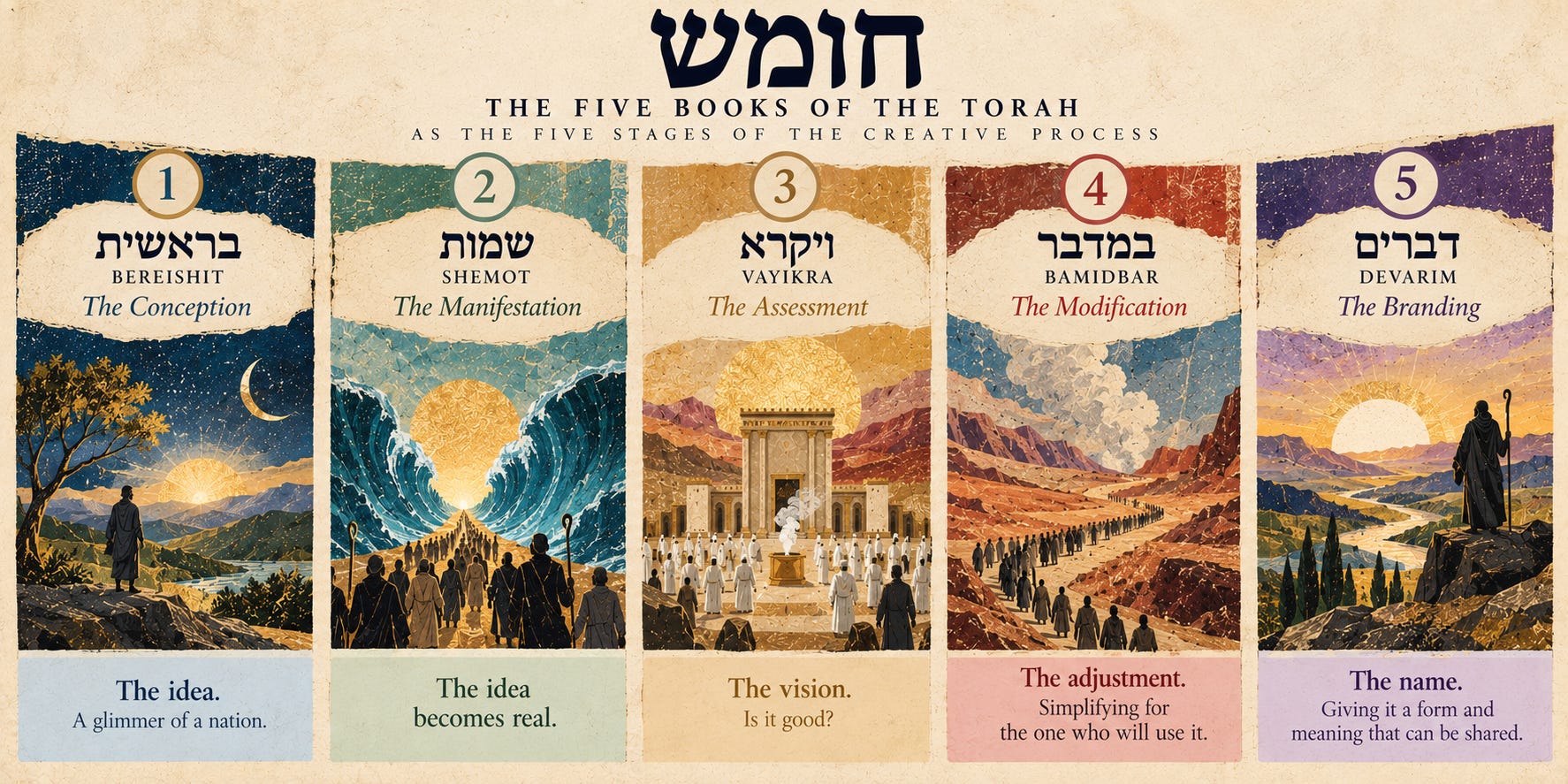
And so the Chumash is not five books simply because a very long Torah needed to be divided into manageable volumes. It’s not very long at all. The five are themselves part of the teaching.
Bereishit is conception.
Shemot is manifestation.
Vayikra is assessment.
Bamidbar is modification.
Devarim is articulation.
And perhaps this explains something deeper about why the Torah begins with creation.
God could have said, “Let there be light,” and there could have been light. Done. Instead, the Torah slows the process down. There is an idea. The idea becomes real. God looks at and assesses what He has made. He modifies it for those who will receive it. And finally, He gives it a name.
Five stages.
Then, the Torah goes on to chronicle how this creative process continues to unfold. An idea of a people emerges. That people becomes real. We see the vision of what it could be. The vision has to adapt to those who actually have to live it. And finally, Moshe gives that experience words so that it can outlive the generation that experienced it.
We call the whole thing Chumash-חומש. The Five Volume Guide to Creation.
Nothing worth creating arrives fully formed. Not a work of art. Not an idea. Not a human being. Not a nation.
Creation is not the moment when something appears. Creation is the process by which an idea becomes something the world can receive.
Sign up for Meaning Within. Coming Soon!

I put “Jewishness” in quotation marks because "Jewishness” as a term is an anachronism here. It is with Avraham that the Torah begins the story of the patriarchs of the Jewish people, even though Terach, his father, is obviously also our biological ancestor.
Rav Tzaddok HaKohen refers to this principle in a number of places as a tradition he received from his teachers (Pri Tzaddik, Bamidbar, Rosh Chodesh Tammuz 1; Yisrael Kedoshim 7:1; Machshavos Charutz 19). The B’nei Yissaschar mentions it as well in Iyar 3:1. They both note that the Gemara uses this methodology in Bava Kama 55a, which discusses the meaning of seeing the letter ט in a dream. The Gemara asserts that the letter ט should be associated with positivity, as in the word טוב, and not negativity, as in the word טומאה, because the first place that this letter appears in the Torah is in the word טוב in the verse: “וירא א-להים את האור כי טוב.”
Indeed, the Ramban describes Bereishit as the book of creation—not only the creation of the universe, but also the formation of the patriarchs, whose lives lay the foundations for the nation to come.
According to the way Rashi reads Bereishit, the pesukim should be read: “In the beginning of God’s creation of the Heavens and the Earth, when the earth was astonishingly empty, and the spirit of God hovered over the face of the deep, God said, ‘There will be light,’ and there was light.”
Midrash is a body of literature that analyzes oddities in the Torah’s text as riddles, and explains them with riddles of its own.
Midrash Rabbah 3:5 as explained by my rebbi Rabbi Beryl Gershenfeld.
Take, for example, the clumsy, contradictory, instinctual prayer of the Jews at the Sea of Reeds before it split.
For example, Pesach Sheini or inheritance of women in the land of Israel.